 Save the Village
Roots and branches belong together.
Western farm communities show the vision in practice. India's villages are the living roots that also need care, service, and renewed strength.
Prabhupada's vision
Save the Village exists because His Divine Grace A.C. Bhaktivedanta Swami Srila Prabhupada, Founder-Acharya of ISKCON, repeatedly connected Krishna consciousness with villages, land, cows, food, books, cooperative community, and simple living with high thinking.
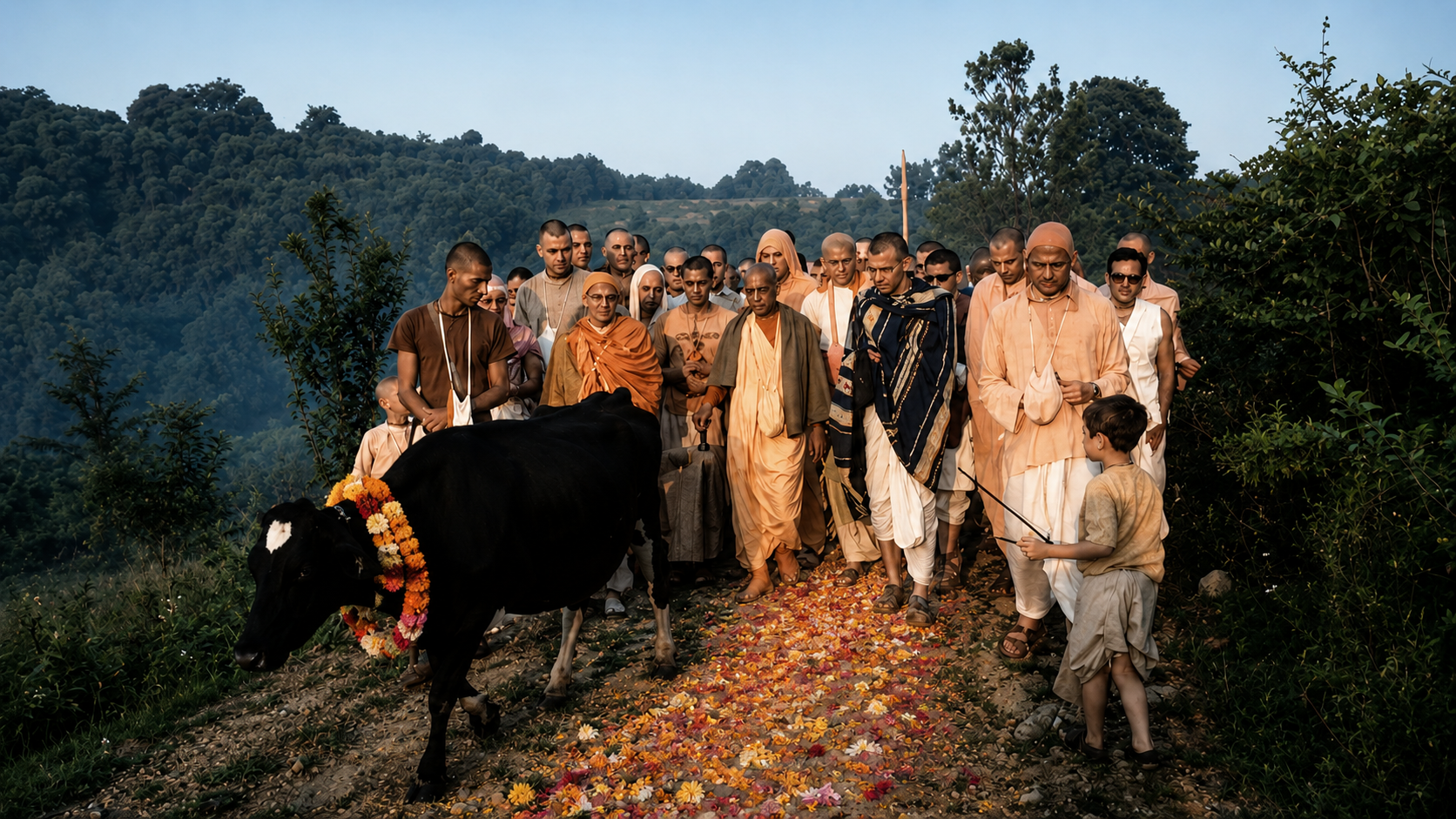
Living guidance
Srila Prabhupada taught that human life becomes peaceful and purposeful when food, cows, land, worship, learning, and community are centered on Krishna. Save the Village carries that guidance into village service in Vidisha.
Roots and branches
Srila Prabhupada planted farm communities in the West as living examples of simple living and high thinking. Save the Village also turns attention toward India's villages, where sacred memory, cow culture, temple life, family vocation, and devotional community still have living roots.
Western farm communities show the vision in practice. India's villages are the living roots that also need care, service, and renewed strength.
ADF is not bringing dignity from outside. The work is to help protect, strengthen, and sanctify village culture already present in local life.
Letter to Bahulasva das · September 29, 1976 · Vrindaban
"Krishna Himself was a villager... Vrindaban means village."
In this letter, Srila Prabhupada welcomes the idea of opening a farm and then gives the deeper reason: people should not be pushed away from village life into towns. He connects village life directly with Krishna's own Vrindaban identity, showing that rural culture is not a side issue but part of the spiritual imagination of the movement.
For Save the Village: village revival means making villages meaningful places to live, worship, grow food, protect cows, raise families, and serve Krishna.
Letter to Nityananda das · July 1, 1975
"Raise their own foodstuffs and have sufficient milk..."
Srila Prabhupada praises a farm with open land, cows, and sheds, then explains why the project matters: self-sufficiency in food and milk gives people time to chant Hare Krishna. The point is not rustic nostalgia. The point is freeing human life from unnecessary labor so spiritual life can become practical.
For Save the Village: books, satsang, cows, food, and local field relationships belong together because they restore time and dignity for devotional life.
Letter to Rupanuga das · December 18, 1974 · Bombay
"An ideal society depending on natural products not industry."
Srila Prabhupada instructs that farm projects should develop self-sufficiency through grains and milk, and he contrasts natural dependence with industrial dependence. He links food, rain, chanting, health, and poverty into one social vision: spiritual culture needs a practical economic base.
For Save the Village: land, water, cows, food, and Krishna-centered culture belong together as one integrated model, not separate programs.
Room Conversation with Allen Ginsberg · May 11, 1969 · Columbus
"A cow and four acres of land..."
In a practical conversation about farm life, Srila Prabhupada gives a compact economic principle: local land and cow protection can support independence anywhere in the world. He immediately connects this principle with New Vrindaban as the place to demonstrate it.
For Save the Village: cow protection is not only sentiment. It belongs to food security, soil care, household resilience, and village stability.
Letter to Hayagriva das · June 14, 1968 · Montreal
"Nature's beauty and nature's protection."
Srila Prabhupada advises that West Virginia be developed as New Vrindaban, with names such as New Govardhana, Syamakunda, and Radhakunda where the landscape allows. He warns against over-modernizing and describes a healthy natural life centered on Krishna consciousness, sufficient land, crops, pasturing grounds, grains, fruits, and milk.
For Save the Village: sacred ecology is not decoration. Kundas, vanas, cows, Govardhan remembrance, and village simplicity make Vraja consciousness visible through land and water.
Tamala Krishna Goswami's Diary · August 9-10, 1977
"Book distribution and farms... our solid programs."
In Srila Prabhupada's final months, the diary records his urgency around farms, book distribution, and the practical demonstration of varnasrama. The farm is where worship, work, education, food, cows, and community can be organized around Krishna in a visible way.
For Save the Village: Graam Vidya Daan begins with Srila Prabhupada's books, then grows through satsang, cow protection, ecology, livelihood, and long-term village relationships.
A call to service
For donors working in technology, business, or professional life, the invitation is not to reject capacity. It is to use capacity in seva. Education, wealth, networks, and management become powerful when placed in service to Krishna-centered village revival.
Next